Hungarian citizenship law
Hungary provides several pathways to citizenship, each tailored to specific criteria and circumstances. Individuals can choose the most suitable option based on factors like ancestral ties, familial connections, investment prospects, or duration of residency.
The basic rules for obtaining Hungarian citizenship are established in Act LV of 1993 on Hungarian Citizenship[1].
Hungarian citizenship cannot be obtained by investment, but foreigners can get a Hungary Golden Visa, which can eventually lead to citizenship. This type of visa was introduced in 2023, enabling third-country nationals to acquire a residence permit in Hungary by investing at least €250,000.

Participants of the investment program can invest in local real estate funds or make donations to higher education institutions. After 11 years of living in Hungary, investors may become eligible for citizenship by naturalisation.
The primary routes available for individuals seeking Hungarian citizenship are as follows:
- Birth: available for children born to Hungarian parents.
- Naturalisation: requires a period of legal residency in Hungary.
- Descent: designed for individuals with Hungarian ancestry.
- Marriage: applicable to foreign nationals wedded to Hungarian citizens.
- Family reunification: open to relatives of Hungarian citizens.
- Declaration: special cases, including refugees and stateless persons.
Ways to obtain Hungarian citizenship
| Route to citizenship | Who is eligible | Main requirements |
| Citizenship by birth | Children with at least one Hungarian parent, eligible adopted children, and children found in Hungary whose parents are unknown | Citizenship is acquired automatically. No residence or language requirements apply |
| Hungary citizenship by descent | Foreigners with Hungarian ancestors or family roots in former Hungarian territories | Proof of Hungarian ancestry and knowledge of the Hungarian language. No residence in Hungary is required |
| Hungary citizenship by marriage | Foreign spouses of Hungarian citizens | Ordinary naturalisation requires qualifying residence in Hungary. Simplified naturalisation is available after 10 years of marriage, or 5 years if the couple has a child |
| Citizenship by naturalisation | Foreign nationals who have legally resided in Hungary for an extended period | Generally, 8 years of qualifying residence, typically following around 3 years of temporary residence, plus Hungarian language proficiency and a citizenship test |
| Citizenship through family reunification | Eligible relatives of Hungarian citizens or individuals recognised as refugees in Hungary | A qualifying family relationship and lawful residence in Hungary. The required residence period depends on individual circumstances |
| Citizenship by declaration | Certain former Hungarian citizens, stateless persons, refugees, and eligible children born in Hungary | Proof of eligibility under special legal provisions, with residence and language requirements where applicable |
7 benefits of being a citizen of Hungary
Hungarian citizenship offers extensive rights and freedoms within the European Union, access to quality healthcare and education, and the ability to live, work, and travel across Europe. It also ensures political participation, family security, and broad international mobility.
EU passport benefits
Hungarian citizens can live, work and study in any of the 29 EU countries without additional work permits or visas[2]. They can stay in another EU country for up to 3 months with a valid passport or national ID card. Longer stays may require registration with local authorities and meeting applicable residence conditions.
Access to social services
Citizens can access Hungary’s public healthcare, education and social welfare systems, subject to applicable eligibility requirements. Those covered by Hungarian public health insurance can obtain a European Health Insurance Card, EHIC. It provides access to medically necessary state-provided healthcare during temporary stays in 27 EU countries, Iceland, Liechtenstein, Norway, Switzerland and the UK.
Voting rights
Hungarian citizens have the right to vote in national and local elections and stand for public office in Hungary, subject to electoral requirements. Those residing in another EU country can also vote and stand as candidates in municipal and European Parliament elections there under the same conditions as local citizens.
Travel benefits
Hungarian passport holders enjoy visa-free, visa-on-arrival or electronic travel authorisation access to more than 170 countries and territories, including popular destinations such as the US, the UK, Japan and Singapore.
Travel to the US is possible under the Visa Waiver Program with an approved ESTA, while Canada generally requires an electronic travel authorisation for air travel.
Electronic travel authorisations and some arrival cards must be completed before departure. Where the source does not state the permitted duration, it is marked as not specified.
Visa-free and visa-on-arrival destinations for Hungarian passport holders
| No. | Country or territory | Permitted stay | Entry requirements |
| 1 | Albania | 90 days | Visa-free |
| 2 | Andorra | Not specified | Visa-free |
| 3 | Angola | 30 days | Visa-free |
| 4 | Antigua and Barbuda | 180 days | Visa-free |
| 5 | Argentina | 90 days | Visa-free |
| 6 | Armenia | 180 days | Visa-free |
| 7 | Australia | 90 days | eVisitor |
| 8 | Austria | 3 months initially | Free movement |
| 9 | Azerbaijan | 30 days | eVisa |
| 10 | Bahamas | 90 days | Visa-free |
| 11 | Bahrain | 30 days | Visa on arrival or eVisa |
| 12 | Bangladesh | 30 days | Visa on arrival |
| 13 | Barbados | 90 days | Visa-free |
| 14 | Belarus | 30 days | Visa-free |
| 15 | Belgium | 3 months initially | Free movement |
| 16 | Belize | Not specified | Visa-free |
| 17 | Benin | 30 or 90 days | eVisa |
| 18 | Bolivia | 90 days | Visa-free |
| 19 | Bosnia and Herzegovina | 90 days | Visa-free |
| 20 | Botswana | 90 days | Visa-free |
| 21 | Brazil | 90 days | Visa-free |
| 22 | Brunei | 90 days | Visa-free |
| 23 | Bulgaria | 3 months initially | Free movement |
| 24 | Burundi | 30 days | Visa on arrival or eVisa |
| 25 | Cambodia | 30 days | Visa on arrival or eVisa |
| 26 | Canada | 180 days | eTA |
| 27 | Cape Verde | 30 days | Visa-free, EASE registration |
| 28 | Chad | Not specified | eVisa |
| 29 | Chile | 90 days | Visa-free |
| 30 | China | 30 days | Visa-free |
| 31 | Colombia | 90 days | Visa-free |
| 32 | Comoros | 45 days | Visa on arrival |
| 33 | Democratic Republic of the Congo | 7 days | eVisa |
| 34 | Costa Rica | 180 days | Visa-free |
| 35 | Côte d’Ivoire | 90 days | Pre-enrolment |
| 36 | Croatia | 3 months initially | Free movement |
| 37 | Cuba | 90 days | eVisa |
| 38 | Cyprus | 3 months initially | Free movement |
| 39 | Czech Republic | 3 months initially | Free movement |
| 40 | Denmark | 3 months initially; longer under EU rules | Free movement |
| 41 | Djibouti | 90 days | Visa on arrival or eVisa |
| 42 | Dominica | 180 days | Visa-free |
| 43 | Dominican Republic | 30 days | Visa-free, E-Ticket |
| 44 | Ecuador | 90 days | Visa-free |
| 45 | Egypt | 30 days | Visa on arrival or eVisa |
| 46 | El Salvador | 180 days | Visa-free |
| 47 | Estonia | 3 months initially; longer under EU rules | Free movement |
| 48 | Eswatini | 30 days | Visa-free |
| 49 | Ethiopia | 90 days | Visa on arrival or eVisa |
| 50 | Fiji | 120 days | Visa-free |
| 51 | Finland | 3 months initially | Free movement |
| 52 | France | 3 months initially | Free movement |
| 53 | Gabon | 90 days | eVisa |
| 54 | Gambia | 90 days | Visa-free |
| 55 | Georgia | 360 days | Visa-free |
| 56 | Germany | 3 months initially | Free movement |
| 57 | Greece | 3 months initially | Free movement |
| 58 | Grenada | 90 days | Visa-free |
| 59 | Guatemala | 90 days | Visa-free |
| 60 | Guinea | 90 days | eVisa |
| 61 | Guinea-Bissau | 90 days | Visa on arrival |
| 62 | Haiti | 90 days | Visa-free |
| 63 | Honduras | 90 days | Visa-free |
| 64 | Hong Kong | 90 days | Visa-free |
| 65 | Iceland | 3 months initially | Free movement |
| 66 | India | 30 days | eVisa |
| 67 | Indonesia | 30 days | Visa on arrival or eVisa |
| 68 | Ireland | 3 months initially | Free movement |
| 69 | Israel | 90 days | eTA |
| 70 | Italy | 3 months initially | Free movement |
| 71 | Jamaica | 30 days | Visa-free |
| 72 | Japan | 90 days | Visa-free |
| 73 | Jordan | 30 days | Visa on arrival or eVisa |
| 74 | Kazakhstan | 30 days | Visa-free |
| 75 | Kenya | 90 days | eTA |
| 76 | Kiribati | 90 days | Visa-free |
| 77 | Kosovo | 90 days | Visa-free |
| 78 | Kuwait | 90 days | Visa on arrival or eVisa |
| 79 | Kyrgyzstan | 30 days | Visa-free |
| 80 | Laos | 30 days | eVisa |
| 81 | Latvia | 3 months initially | Free movement |
| 82 | Lebanon | 30 days | Visa on arrival |
| 83 | Lesotho | 14 days | Visa-free |
| 84 | Liechtenstein | 3 months initially | Free movement |
| 85 | Lithuania | 3 months initially | Free movement |
| 86 | Luxembourg | 3 months initially | Free movement |
| 87 | Macao | 90 days | Visa-free |
| 88 | Madagascar | 90 days | Visa on arrival or eVisa |
| 89 | Malawi | 30 days | Visa on arrival or eVisa |
| 90 | Malaysia | 90 days | Visa-free, Arrival Card |
| 91 | Maldives | 30 days | Visa on arrival |
| 92 | Malta | 3 months initially | Free movement |
| 93 | Marshall Islands | 90 days | Visa-free |
| 94 | Mauritius | 90 days | Visa-free |
| 95 | Mexico | 180 days | Visa-free |
| 96 | Micronesia | 90 days | Visa-free |
| 97 | Moldova | 90 days | Visa-free |
| 98 | Monaco | Not specified | Visa-free |
| 99 | Mongolia | 30 days | Visa-free |
| 100 | Montenegro | 90 days | Visa-free |
| 101 | Morocco | 90 days | Visa-free |
| 102 | Mozambique | 30 days | Visa on arrival or eVisa |
| 103 | Myanmar | 28 days | eVisa |
| 104 | Namibia | 90 days | Visa on arrival or eVisa |
| 105 | Nepal | 150 days | Visa on arrival or eVisa |
| 106 | Netherlands | 3 months initially | Free movement |
| 107 | New Zealand | 90 days | eTA |
| 108 | Nicaragua | 90 days | Visa-free |
| 109 | Nigeria | 30 days for a tourist eVisa | eVisa |
| 110 | North Macedonia | 90 days | Visa-free |
| 111 | Norway | 3 months initially | Free movement |
| 112 | Oman | 30 days | Visa on arrival or eVisa |
| 113 | Pakistan | Up to 90 days | eVisa |
| 114 | Palau | 90 days | Visa-free |
| 115 | Palestinian Territories | Not specified | Visa-free |
| 116 | Panama | 90 days | Visa-free |
| 117 | Papua New Guinea | 60 days | eVisitor |
| 118 | Paraguay | 90 days | Visa-free |
| 119 | Peru | 180 days | Visa-free |
| 120 | Philippines | 30 days | Visa-free |
| 121 | Poland | 3 months initially | Free movement |
| 122 | Portugal | 3 months initially | Free movement |
| 123 | Qatar | 30 days | Visa on arrival or eVisa |
| 124 | Romania | 3 months initially | Free movement |
| 125 | Rwanda | 30 days | Visa on arrival or eVisa |
| 126 | Saint Kitts and Nevis | 90 days | eTA |
| 127 | Saint Lucia | 90 days | Visa-free |
| 128 | Samoa | 90 days | Visa-free |
| 129 | San Marino | Not specified | Visa-free |
| 130 | Sao Tome and Principe | 15 days | Visa-free |
| 131 | Saudi Arabia | 90 days | Visa on arrival or eVisa |
| 132 | Senegal | 90 days | Visa-free |
| 133 | Serbia | 90 days | Visa-free |
| 134 | Seychelles | 90 days | Visa-free, tourist registration |
| 135 | Sierra Leone | 30 days | Visa on arrival or eVisa |
| 136 | Singapore | 90 days | Visa-free, Arrival Card |
| 137 | Slovakia | 3 months initially | Free movement |
| 138 | Slovenia | 3 months initially | Free movement |
| 139 | Solomon Islands | 90 days | Visa-free |
| 140 | Somalia | Not specified | eVisa |
| 141 | South Africa | 30 days | Visa-free |
| 142 | South Korea | 90 days | Visa-free |
| 143 | Spain | 3 months initially | Free movement |
| 144 | Sri Lanka | 30 days | eTA |
| 145 | St. Vincent and the Grenadines | 90 days | Visa-free |
| 146 | Suriname | 90 days | Tourist card |
| 147 | Sweden | 3 months initially | Free movement |
| 148 | Switzerland | 3 months initially | Free movement |
| 149 | Syria | 30 days | Visa on arrival or eVisa |
| 150 | Taiwan | 90 days | Visa-free |
| 151 | Tajikistan | 30 days | Visa-free |
| 152 | Tanzania | Not specified | Visa on arrival or eVisa |
| 153 | Thailand | 30 days | Visa-free, Arrival Card |
| 154 | Timor-Leste | 90 days | Visa-free |
| 155 | Tonga | 90 days | Visa-free |
| 156 | Trinidad and Tobago | 90 days | Visa-free |
| 157 | Tunisia | 90 days | Visa-free |
| 158 | Tuvalu | 90 days | Visa-free |
| 159 | Türkiye | 90 days | Visa-free |
| 160 | Uganda | Not specified | eVisa |
| 161 | Ukraine | 90 days | Visa-free |
| 162 | United Arab Emirates | 90 days | Visa-free |
| 163 | United Kingdom | 180 days | eTA |
| 164 | United States of America | 90 days | ESTA |
| 165 | Uruguay | 90 days | Visa-free |
| 166 | Uzbekistan | 30 days | Visa-free |
| 167 | Vanuatu | 120 days | Visa-free |
| 168 | Vatican City | Not specified | Visa-free |
| 169 | Venezuela | 90 days | Visa-free |
| 170 | Viet Nam | 45 days | Visa-free |
| 171 | Zambia | 90 days | Visa-free |
| 172 | Zimbabwe | 90 days | Visa on arrival or eVisa |
Consular protection
Hungarian citizens can seek assistance from Hungarian embassies and consulates abroad in emergencies, including lost passports, accidents or legal difficulties.
If Hungary has no diplomatic representation in a non-EU country, its citizens can request consular protection from the embassy or consulate of another EU member state.
Economic opportunities
Hungarian citizens can work, establish businesses and pursue self-employment across the EU without obtaining separate work permits. They can also open bank accounts, apply for mortgages and business loans, and invest through European financial institutions, subject to standard eligibility checks. Access to the EU single market creates opportunities for entrepreneurship and cross-border business expansion.
Family reunification
Hungarian citizens can sponsor eligible family members, including spouses and dependent children, for residence in Hungary. Under EU free movement rules, qualifying non-EU relatives can also accompany or join Hungarian citizens relocating to another EU country. Children born to at least one Hungarian parent generally acquire Hungarian citizenship automatically, regardless of their place of birth.

Hungary citizenship by investment: how to get a Hungarian passport after the Hungary Golden Visa
Hungary does not offer citizenship directly by investment. However, foreign investors can obtain a residence permit through the Hungary Golden Visa programme, introduced in 2024, and eventually qualify for citizenship by naturalisation.
The programme includes two investment options:
- Purchase of investment fund units for €250,000+. The chosen investment fund must be registered with the Central Bank of Hungary, Magyar Nemzeti Bank, and have at least 40% of its net assets invested in Hungarian residential real estate. Investors must hold the fund units for at least 5 years.
- Financial donation of €1,000,000+ to a higher education institution maintained by a public-interest asset management foundation. The donation is non-refundable.
Investors first obtain a Guest Investor Visa, valid for up to 6 months[3]. The investment must be completed before applying for a residence permit, and the application must be submitted within 30 days of the first entry to Hungary on this visa.
A residence permit by investment is issued for 10 years and can be extended once for another 10 years. The Hungary Golden Visa programme does not require investors to live in the country to maintain their residence permit. However, those seeking Hungarian citizenship must establish actual residence in Hungary and meet the requirements for naturalisation.
Investors can apply for permanent residency after 3 years of residence in Hungary. Obtaining this status is an important step towards citizenship, although it does not automatically make investors eligible for naturalisation. Permanent residents can live in the country indefinitely without renewing their residence status, although the residence permit card must be renewed every 10 years.
To qualify for Hungarian citizenship, investors must then complete 8 years of residence and meet the standard naturalisation requirements, including:
- knowledge of Hungarian,
- stable source of income,
- passing a citizenship test.
They must also have a registered permanent address in Hungary, which can be an owned or rented property. In total, obtaining citizenship through the Golden Visa route typically takes at least 11 years of residence, depending on individual circumstances.
Get our complete guide to explore the benefits, requirements, and application process for Hungary Golden Visa applicants.
Hungarian citizenship by naturalisation
Hungarian citizenship by naturalisation is a path for long-term residents who have built stable lives in the country. It requires several years of lawful residence, integration into Hungarian society, and knowledge of the language.
Residency requirements
Applicants for Hungarian citizenship by naturalisation must live in Hungary for 3 years with a temporary residence permit and 8 years with permanent residency.
When a foreigner receives a permanent residence card, they can register their permanent address, and the countdown for naturalisation begins. To qualify for citizenship, one must live in permanent residence status for another 8 years. Coupled with temporary and permanent residence permits, an individual must live in Hungary for over 11 years.
To maintain the permanent residence status, foreigners must not leave Hungary for more than 6 consecutive months. If they plan to leave Hungary for a longer period, they must notify the Immigration Office of Hungary. If the applicant has spent at least 180 days in Hungary during the 365 days before the notice, they will most likely be granted a permission to stay outside Hungary for up to two years without forfeiting permanent residency.
Additional requirements
Other requirements for applicants for citizenship by naturalisation include the following:
- knowledge of the Hungarian language;
- absence of criminal records and other convictions;
- compliance with all public and national security requirements of Hungary;
- passing the citizenship test;
- stable source of income;
- permanent address in Hungary.
The citizenship test assesses knowledge of Hungarian history, the constitution and civic institutions. Certain applicants are exempt from the examination, including those aged 60 or over, people who have completed education in Hungarian and individuals with qualifying medical conditions.
The final decision on naturalisation is made by the President of Hungary. Once approved, applicants generally acquire citizenship on the date they take the citizenship oath or affirmation.
Conditions for simplified naturalisation
Certain categories of foreigners are eligible for preferential naturalisation under Section 4 of Act LV of 1993. The required residence period depends on the applicant’s circumstances.
A reduced residence requirement of 3 years applies to certain applicants, including recognised refugees, stateless persons, foreign spouses who have been married to Hungarian citizens for at least 3 years, and applicants with a minor child who holds Hungarian citizenship.
A 5-year residence requirement may apply to foreigners born in Hungary or those who established their registered residence in the country before reaching adulthood.
Foreigners with qualifying Hungarian ancestry can apply through simplified naturalisation without prior residence in Hungary. A similar exemption applies to spouses of Hungarian citizens after 10 years of marriage, or 5 years if the couple has a child together.
Applicants using the ancestry-based or long-marriage simplified naturalisation routes are not required to pass the standard citizenship test. However, they must demonstrate knowledge of the Hungarian language.
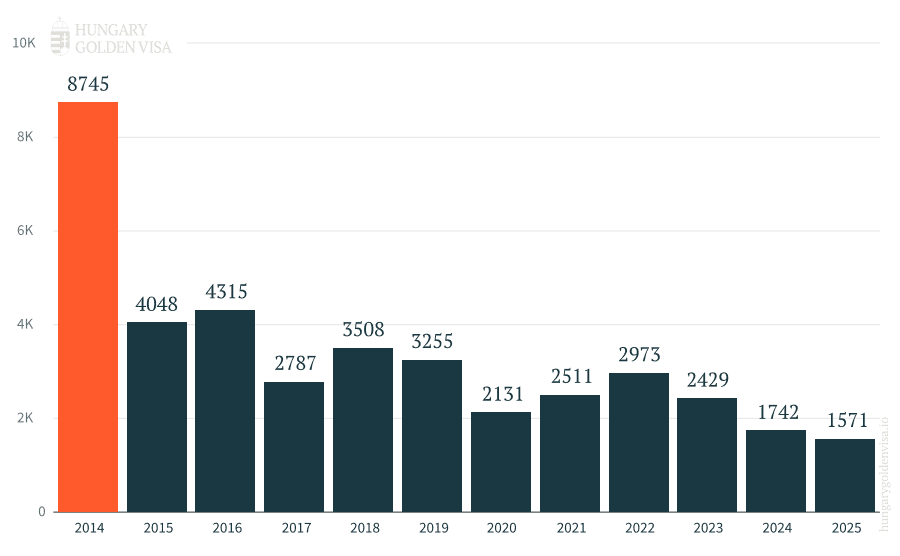
The number of naturalised citizens in Hungary over the past 10 years
Hungarian citizenship by birth
Children of Hungarian citizens automatically acquire Hungarian nationality at birth, regardless of the country of birth.
A child can obtain Hungarian citizenship by birth under one of the following conditions:
- at least one of their parents is a Hungarian citizen;
- they are under 18 and adopted by Hungarian citizens;
- they are under 18 and found on Hungarian territory, with unidentified parents.
Foreign children under 18 who are adopted by Hungarian citizens may also qualify for citizenship through preferential naturalisation. However, adoption does not automatically grant citizenship by birth.
In cases where it is necessary to confirm citizenship by birth, parents must submit an application on behalf of the child. They have to obtain a certificate of citizenship using a simplified procedure, as well as submit the following documents:
- an application form for citizenship, which is called Honosítási, Visszahonosítási kérelem in Hungarian;
- an application form for registration of the birth of a child — Születés hazai anyakönyvezéséhez;
- a birth certificate translated into Hungarian and certified by a notary;
- the parents’ marriage certificate;
- a copy of the passport of one of the parents if they are not a Hungarian citizen.
If the Hungarian parent’s citizenship cannot be established from the available documents, a separate citizenship verification procedure may be necessary.
Birth registration is free of charge and takes 2—4 months when processed through a Hungarian consulate, although timelines vary. Parents may also submit a Hungarian passport application for their child during the registration process.
Hungarian passport by marriage
Hungarian citizenship by marriage can be obtained in two ways: through ordinary or simplified procedure. The former requires residence in Hungary, while the latter is available regardless of where the applicant lives.
If the marriage was registered abroad, it is necessary to register it in Hungary. This can be arranged as part of the naturalisation application process[8].
Naturalisation for spouses residing in Hungary
Applicants for citizenship by marriage must:
- have been legally married to a Hungarian citizen for at least 3 years, unless the marriage ended due to the Hungarian spouse’s death;
- have lived continuously in Hungary for at least 3 years before applying;
- have a place of accommodation in Hungary and sufficient means of subsistence;
- have no disqualifying criminal record and meet public safety and national security requirements;
- pass the citizenship test in Hungarian, unless exempt.
Foreign spouses may become eligible for a national residence card, which grants permanent residence, after at least 2 years of marriage to a Hungarian citizen. However, obtaining permanent residence does not automatically grant citizenship.
Simplified naturalisation
Under the simplified naturalisation process, the country of residence does not matter. The applicant is also not required to continuously reside in Hungary, have a place of accommodation there, prove sufficient means of subsistence, or pass the citizenship test. The main eligibility requirement is the length of the marriage.
To qualify for Hungary citizenship by marriage through simplified naturalisation, the applicant must:
- have been legally married to a Hungarian citizen for at least 10 years, or at least 5 years if the couple has a child together;
- ensure that the spouse holds Hungarian citizenship at the time of application, regardless of when or how it was obtained;
- prove knowledge of the Hungarian language;
- have no disqualifying criminal record or pending criminal proceedings and meet public safety and national security requirements.
Hungary citizenship by descent
Hungary offers citizenship by descent to individuals who can prove their direct lineage to a Hungarian ancestor. Applicants can apply through a simplified naturalisation process, which considers ancestors as distant as great-grandparents or older generations.
Eligible ancestors include those who were Hungarian citizens or lived in Hungary’s former territories before its borders changed. Such territories include the modern Southern Slovakia, Transylvania, the Transcarpathian region of Ukraine, or Vojvodina before 1920 or between 1938 and 1945.
Simplified naturalisation does not require applicants to live in Hungary. However, they must demonstrate sufficient knowledge of Hungarian, have no disqualifying criminal record, and meet the country’s public safety and national security requirements.
There is no language examination, as proficiency is assessed through communication with officials.
The Hungary citizenship by descent process involves submitting an application to the relevant Hungarian authorities, including a Hungarian embassy or consulate abroad, and providing the following documents:
- completed naturalisation application form and a handwritten CV, where required;
- valid international passport or identity card;
- applicant’s birth certificate;
- certificates of marriage, divorce, and birth of children, where applicable;
- birth, death, and marriage certificates of the applicant’s parents and ancestors through whom citizenship is claimed;
- additional evidence of Hungarian ancestry, such as historical residence records, church certificates, military records, or school documents;
- certified Hungarian translations of foreign documents and apostilles or legalisation, where required.
Applicants must submit documents establishing the family connection across every generation. During the application appointment, officials collect photographs and biometric data and assess Hungarian language proficiency.
Hungarian citizenship is acquired upon taking the citizenship oath or affirmation following approval of the simplified naturalisation application. Once citizenship is obtained, applicants can submit a separate application for a Hungarian passport.
Hungary citizenship by family reunification
Hungarian citizenship through family reunification is available to foreign relatives of Hungarian citizens. After obtaining a residence permit, they can apply for citizenship following 3 years of residency in Hungary. This right also applies to relatives of individuals recognised as refugees by Hungary.
To qualify, applicants must provide the following documents verifying family connections established before they arrived in Hungary:
- birth, adoption, and marriage certificates confirming their relationship with the sponsoring family member;
- bank statement, income certificate, or notarised declaration of financial support demonstrating sufficient means of subsistence;
- proof of accommodation in Hungary, such as a rental agreement or property ownership document;
- proof of health insurance or sufficient funds to cover medical expenses;
- valid passport.
Hungary citizenship by declaration
Hungarian citizenship by declaration is available to certain individuals who qualify under special provisions of Act LV of 1993 on Hungarian Citizenship[5]. Unlike standard naturalisation, this procedure applies primarily to historical cases of citizenship loss and specific circumstances involving statelessness.
Eligible applicants include:
- former Hungarian nationals who were deprived of their citizenship under specific laws adopted between 1947 and 1957;
- former Hungarian citizens who were released from citizenship between September 15th, 1947, and May 2nd, 1990;
- individuals who were forced to resettle in Germany after World War II;
- individuals born before October 1st, 1957, to a Hungarian mother and a foreign father who did not acquire Hungarian citizenship at birth;
- stateless individuals born in Hungary to foreign parents who did not pass on their nationality, provided additional residence and age requirements are met.
Former Hungarian citizens applying under the historical provisions do not need to reside in Hungary. They must provide documents confirming their previous citizenship and the circumstances under which it was lost.
Stateless individuals born in Hungary may acquire citizenship by declaration if their parents had registered residence in Hungary at the time of birth. Applicants must have lived in Hungary for at least 5 years immediately before submitting their declaration and must apply before turning 19.
Recognised refugees and other stateless persons who do not qualify for citizenship by declaration may instead apply through preferential naturalisation after 3 years of qualifying residence in Hungary, provided they meet the applicable requirements.
Requirements for citizenship by declaration depend on the applicant’s circumstances and may include:
- proof of identity and a birth certificate;
- documents confirming previous Hungarian citizenship and its loss;
- evidence of Hungarian parentage for applicants born before October 1st, 1957;
- proof of statelessness and qualifying residence in Hungary, where applicable;
- certified Hungarian translations of foreign documents, where required.
Applications can be submitted through a Hungarian embassy or consulate abroad or the relevant government office in Hungary. Once the declaration is accepted, Hungarian citizenship is recognised from the date the declaration was made.
Step-by-step process of obtaining a Hungarian passport
The period of obtaining Hungarian citizenship depends on the chosen path and can span from several months to several years. The naturalisation process takes the longest: initially, the applicant must secure a qualifying residence permit and continuously live in Hungary for 3 years. After this time, they apply for permanent residency which they must hold for a minimum of 8 years before applying for citizenship.
Getting a Hungarian passport includes demonstrating integration into Hungarian society, which often requires passing a language test and showing familiarity with Hungarian culture and laws.
Below is the step-by-step process of acquiring a Hungarian passport by naturalisation after the Hungary Golden Visa.
-
1 dayPreliminary check
Consulting with an expert, such as a lawyer or authorised legal advisor, will help verify that the investor meets the necessary criteria and are likely to fulfil the Hungarian residency requirements.
-
2 weeksPreparing documents and applying for a Guest Investor Visa
When the pack of documents is ready, the application for a Guest Investor Visa can be submitted to the Hungary consulate in one’s country of residence.
-
About 1 monthGuest Investor Visa approval
If the application is approved, the applicant is issued a Guest Investor Visa for 6 months. The visa gives the right to enter Hungary to apply for a residence permit by investment.
With a Guest Investor Visa, one can stay in Hungary for over 90 days within 180 days and enter and leave the country multiple times.
-
Up to 3 monthsFulfilment of the investment condition
Within 93 calendar days from their first entry to the country with a Guest Investor Visa, the applicant must fulfil the investment condition to become eligible to apply for a residence permit.
-
Up to 1 monthResidence permit application
Once the investment is made, the applicant can apply for a residence permit. The investor can submit their application in person at the regional office of the National Directorate-General for Aliens Policing or online via the Enter Hungary platform.
The processing of the residence permit application typically takes 21—30 days. After its approval, the investor books an appointment to submit biometrics to the immigration authority.
-
Up to 3 weeksSubmitting biometrics and getting a residence permit
On the appointed day, the investor submits fingerprints and takes photos. The residence permit card is prepared within 7 days after approval. The immigration authority sends residency cards to the applicant’s address in Hungary within 21 days.
Residence permits will be valid for 10 years and are subject to one renewal for another 10 years.
-
In 3 yearsObtaining permanent residency
Investors can apply for permanent residency after 3 years of residence in Hungary based on their Golden Visa. Permanent residence status is issued for life.
To qualify, applicants must demonstrate that granting them permanent residency is in the interest of Hungary. This can include contributions to the economy, investment in the country, or other significant benefits brought to Hungary through the applicant’s activities.
-
In 8 yearsObtaining citizenship
An application for a Hungarian passport is submitted to the Ministry of Internal Affairs regional office or the Unified Customer Service Office in Budapest. After registration, the application is submitted to the Ministry of Internal Affairs for data verification; then, it is reviewed by the President of Hungary.
Dual citizenship in Hungary
Hungary allows dual citizenship, so foreigners can acquire a Hungarian passport without renouncing their original one.
However, the rules regarding dual citizenship may vary depending on the laws of the applicant’s country. For example, China does not recognise dual citizenship. Chinese citizens who acquire foreign citizenship must renounce their first citizenship.
Hungary citizenship test
A citizenship examination is mandatory in the standard naturalisation process for Hungarian citizenship. This exam assesses the applicant’s knowledge of Hungarian history, culture, and language.
The required level of language proficiency assumes intermediate-level communication skills in Hungarian, which includes comprehension and verbal expression.
Exemptions from the citizenship test include:
- minors with limited legal capacity and individuals who lack legal capacity;
- applicants aged 60 or over at the time of application;
- applicants who have completed education at an institution where Hungarian was the language of instruction;
- individuals who cannot take the examination due to a permanent and irreversible deterioration in their health.
Applicants obtaining Hungary citizenship by descent through simplified naturalisation do not have to pass the standard citizenship test. Instead, their Hungarian language proficiency is assessed through communication with officials during the application process.
For those applying by descent or simplified naturalisation, language proficiency is assessed through alternative methods, such as interviews with officials during the application process.
Why can Hungarian citizenship be denied?
Hungary can deny citizenship applications for various reasons. The decision is based on legal and security considerations and the applicant’s compliance with the Hungarian citizenship requirements.
Lack of eligibility
Applicants must meet the required period of lawful residence, for example, 11 years for naturalisation or 3 years for refugees and stateless persons. Insufficient residency time is a common ground for denial. Failure to demonstrate basic Hungarian language skills, unless exempt, can also lead to rejection. For those applying based on Hungarian descent, inability to provide sufficient proof of Hungarian ancestry or ties can result in denial.
Criminal background
Applicants with a history of serious criminal offenses or ongoing criminal proceedings in Hungary or abroad are typically denied citizenship. Any indication that the applicant poses a threat to public order or safety can also result in rejection.
National security risks
Citizenship may be denied if authorities determine that the applicant poses a risk to national security or Hungary’s international relations. This may include:
- association with extremist groups;
- involvement in espionage or activities against the state;
- past affiliations with organisations considered hostile to Hungary.
False or misleading information
Providing false, incomplete, or misleading information in the citizenship application can lead to immediate denial and, in some cases, legal consequences. Submission of falsified documents, such as fake birth certificates or residence permits, can disqualify the applicant.
Administrative or procedural issues
Missing or incomplete documentation may result in the application being denied or delayed. Not adhering to the application timeline, failing to attend interviews, or not taking the citizenship oath can lead to rejection.
If an application is denied, the decision can often be appealed. Applicants must provide additional evidence or rectify issues identified in the rejection. Meeting all legal and procedural requirements is essential to avoid denial of Hungarian citizenship.
Validity period of a Hungarian passport and how to renew it
The Hungary passport validity periods are as follows:
- 10 years for passports issued to citizens over 18;
- 5 years for passports for children aged 6 to 18,
- 3 years for passports for children under 6[6].
Passport applications for minors require the consent of both parents or legal guardians. Children aged 12 and over must normally attend the appointment to provide fingerprints and a signature.
The following documents are required to renew a Hungarian passport:
- current passport;
- Hungarian ID card or proof of citizenship, like citizenship certificate or birth certificate;
- proof of address;
- birth certificate and parental consent for minor applicants;
- passport-sized photos, typically taken at the application center;
- police report, if renewing due to loss or theft;
- proof of the name change, if the passport holder has changed their name.
The passport renewal process can be started at any time, even before the existing document expires. Hungarian passports cannot be extended, so applicants receive a new document. Applications can be submitted in Hungary at government offices or passport authorities, as well as abroad at Hungarian embassies and consulates.
Standard passport processing in Hungary takes up to 20 days. Expedited services are available domestically for an additional fee, with processing times of 5 days, 3 days or 24 hours. Applications submitted through Hungarian consulates abroad typically take 4—8 weeks, depending on the location. Expedited processing is not available at consulates.
Completed passports can be collected in person or delivered by post, depending on the application location and the selected service.
How does Hungary residence compare with other EU investment programmes?
Several European countries offer residence-by-investment programmes that can eventually lead to EU citizenship. However, none of them automatically grants citizenship. Investors must meet the naturalisation requirements, including residence periods, language proficiency and integration conditions.
Hungary offers one of the more affordable Golden Visa programmes in Europe, with a minimum investment of €250,000. Other EU countries provide similar opportunities, although investment thresholds and paths to citizenship vary. The amounts below represent minimum qualifying investments and exclude additional fees and expenses.
Hungary residence permit vs other EU programmes
| Country and programme | Investment | Permit validity | Processing time | Path to citizenship | Family eligibility |
| Hungary Golden Visa | €250,000+ | 10 years, renewable once for 10 years | 5+ months | 11 years of residence | Spouse or partner, children under 18, parents |
| Malta Permanent Residence Programme | €100,200+ | Permanent | 6+ months | 5 years of residence | Spouse or partner, children under 29, parents, grandparents |
| Greece Golden Visa | €250,000+ | 5 years, renewable | 4+ months | 7 years of residence | Spouse or partner, children under 21, parents |
| Portugal Golden Visa | €250,000+ | 2 years, renewable | 12+ months | 7 or 10 years of residence, depending on nationality | Spouse or partner, children under 26, parents |
| Cyprus Golden Visa | €300,000+ | Permanent | 9+ months | 8 years of residence | Spouse or partner, children under 25 |
| Italy Investor Visa | €250,000+ | 2 years, renewable | 4+ months | 10 years of residence | Spouse, children, parents over 65 |
| Latvia Golden Visa | €50,000+ | 2 years, renewable | 3+ months | 10 years of residence | Spouse, children under 18 |
Taxes and tax residency in Hungary
Hungarian tax residents are generally taxed on their worldwide income, while non-residents pay taxes only on income from Hungarian sources. Tax residency depends on several factors, including citizenship, residence status, time spent in Hungary, and the location of a person’s permanent home and centre of vital interests.
Foreigners may become Hungarian tax residents if they spend at least 183 days in the country during a calendar year or meet other statutory residence criteria. Hungarian citizens are generally considered tax residents, although exceptions apply to certain dual nationals living abroad[7]. Holding a Hungary Golden Visa alone does not automatically establish tax residency.
The main tax rates in Hungary in 2026 are as follows:
- personal income tax — 15% on most taxable income, including salaries and rental income;
- social security contributions — 18.5% of employees’ gross salaries;
- employer social contribution tax — 13% of gross salaries;
- dividend and capital gains tax — 15%, with an additional 13% social contribution tax applicable in certain cases;
- corporate income tax — 9% on taxable company profits;
- value-added tax — 27%, with reduced rates of 5% and 18% for certain goods and services;
- local business tax — up to 2%, depending on the municipality.
Hungary has double taxation treaties with numerous countries to help prevent the same income from being taxed twice. Foreigners planning to obtain Hungarian citizenship should assess their tax obligations before relocating, particularly if they receive income from abroad.
Key takeaways: how to obtain Hungary nationality
- The Hungarian citizenship law, outlined in Act LV of 1993, provides such pathways to citizenship as descent, naturalisation, repatriation, marriage, family reunification, and declaration.
- Hungary does not offer citizenship directly by investment. However, investors can obtain a Hungary Golden Visa, which allows legal residence in the country and can eventually lead to citizenship by naturalisation. The minimum investment under the Hungary Golden Visa program is €250,000.
- Hungarian citizenship allows individuals to live, work, study and access healthcare and social services in Hungary and any other EU country. It also provides visa-free travel to over 170 countries and can be passed to future generations.
- For citizenship by naturalisation, applicants must reside in Hungary for at least 11 years, including 3 years with a residence permit and 8 years with permanent residency, pass a citizenship exam, and prove intermediate proficiency in Hungarian.
- Foreigners applying for Hungarian citizenship by descent, marriage, or declaration are required to meet shorter residency requirements and do not typically have to take the citizenship test.
- Hungary permits dual citizenship, allowing individuals to hold Hungarian citizenship with that of another country.
- Investment amounts
- Requirements for applicants
- Processing time and procedure
Sources
- Source: Hungarian citizenship law, National Legislation Database
- Source: EU movement rights, European Commission
- Source: Guest Investor requirements, National Directorate-General for Aliens Policing
- Source: Hungarian naturalisation statistics, Hungarian Central Statistical Office
- Source: Hungarian citizenship law, National Legislation Database
- Source: Passport validity rules, National Legislation Database
- Source: Personal income tax, National Legislation Database
- Source: Hungarian government, Application form for the domestic registration of a marriage contracted abroad